Many students across India dream of being accepted into a top Management School (the IIMs) directly after completing their Class 12. Admission to the five-year Integrated Management Programme in Management (IPMAT) at The IIMs (e.g., IIM Indore, IIM Rohtak) is determined through the Integrated Programme in Management Admission Test (IPMAT).
In this article, we will identify what distinguishes the IPMAT from other entrance examinations for undergraduate courses and whether its level of difficulty is comparable to those examinations. We will look at the structure of the test, competition levels with the entry examinations, and what skills each test assesses – IPMAT exam all first-year undergraduate management programme aspirants by comparing their difficulty with that of CUET, NPAT, CLAT, JEE, and CAT.
What Makes IPMAT Challenging for Students
In compiling a broad range of subjects and utilizing advanced skills, it requires conceptual understanding, logical deduction, problem-solving, and effective time allocation.
Because the exam measures both speed and accuracy, its difficulty stems primarily from the nature of questioning and composite skill assessment. Additionally, it is competitive due to the limited number of seats available at select universities.
Analysis of prior performance has revealed that quantitative areas include most of the content found in high school mathematics (e.g., algebra, probability, matrices, reasoning), and tests on these topics assess not only accuracy but also performance under time constraints. Recent statistics on admissions to IIM Indore indicate an acceptance rate of less than 1% for applicants.
Each sectional area contains multiple component skills, incorporated together to determine overall success, thereby creating a total exam that is much broader in its coverage of different subject matters, with more focus on how these areas interact with one another.
How IPMAT Compares with Other Undergraduate Entrance Exams
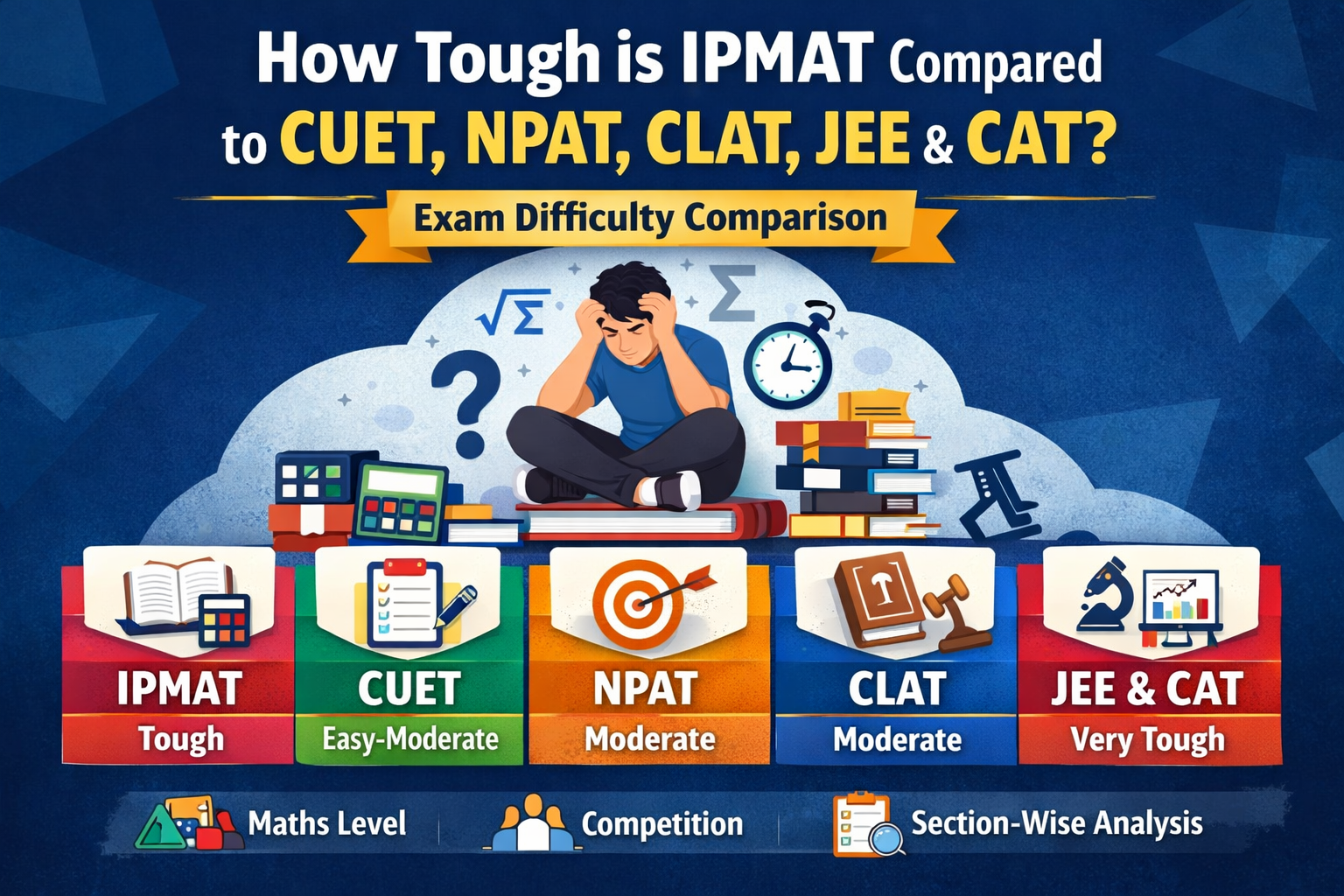
To put the difficulty of IPMAT into perspective, it helps to compare it with several other well-known undergraduate entrance tests. The following table outlines major differences in syllabus coverage and perceived difficulty:
| Exam | Test Focus | Difficulty Level | Why |
| IPMAT (Indore/Rohtak) | Quantitative Ability, Verbal Ability, (Logical Reasoning for Rohtak) | Moderate to High | Includes advanced maths (Class 12 level) and requires a balance of speed and accuracy across multiple sections. |
| CUET (UG) | Subject knowledge as well as aptitude | Easy to Moderate | Focus on subject knowledge and comprehension rather than deep analytical reasoning. |
| NPAT (NMIMS) | Quantitative, Reasoning, English | Moderate | Less mathematical depth and no short-answer questions; generally smoother for most students. |
| SET (Symbiosis) | English, QA, GA, Reasoning | Easy to Moderate | Basic maths and inclusion of general awareness; fewer tricky quantitative concepts. |
| CLAT (Law) | English, LR, GK, Legal Aptitude | Moderate | Less focus on maths; tougher reading comprehension and reasoning disciplines. |
| JEE Main | Physics, Chemistry, Mathematics | Very High | Highly technical and extensive syllabus; depth of understanding required is greater than UG management tests. |
| CAT (PG level) | VARC, DILR, QA | Very High | Designed for post-graduates, deeper analytical and data interpretation skills. |
From this table, some clear trends emerge:
- The IPMAT (Integrated Program in Management Admission Test) is significantly harder than other BBA (Bachelor of Business Administration) entrance tests in terms of its Mathematics and Verbal Ability exams when compared to other BBA admission tests (NPAT, SET).
- The IPMAT’s quantitative portion is much more rigorous than that of most other undergraduate (UG) admissions tests.
- The IPMAT is much more difficult to pass because it tests the ability to reason and apply what you have learned as opposed to just your knowledge from using standardized reference sources (CUET).
- When comparing the IPMAT with similar very high-pressure professional admissions examinations (JEE Main and CAT), in general, the IPMAT is less intensive regarding the depth of concepts; however, because of its integrated sections and time to study for the boards, the IPMAT is seen as more rigorous by students in its own target group of students.
Section-Wise Difficulty Breakdown
Understanding the particular challenge of each section further clarifies why IPMAT is considered relatively tough:
Quantitative Ability
This is widely regarded as the most demanding section. IPMAT quantitatively tests not just basic mathematical concepts from the syllabus but also more complex applications of those topics. Many students find the level higher than typical BBA entrances and closer, in some ways, to the quantitative demands of postgraduate tests.
Verbal Ability
This section assesses deep reading comprehension, grammar, vocabulary, and logical inference. Students from non-English intensive backgrounds often find this section equally challenging.
Logical Reasoning (Rohtak)
For candidates appearing at IPMAT Rohtak, the logical reasoning section adds another layer of analytical complexity that is not common in many UG exams.
Competition and Selection Pressure
Competition, rather than just the question type, determines the level of difficulty. IPMAT has a high number of applicants, approximately 20,000 to 30,000+ individuals competing for fewer than several hundred seats available in IIM’s, placing considerable selection pressure on applicants competing against each other than is experienced in other UG entrance examinations which have larger capacity intakes across multiple universities.
As opposed to IPMAT, CUET and SET examinations lead to admissions into larger universities which take in larger numbers of applicants; therefore, relative competition for individual seats is dissipated and spread out across all of these institutions.
Comparisons with Similar Competitive Exams
IPMAT vs CLAT
Another well-known undergraduate entrance exam is the CLAT (Common Law Admission Test). Unlike IPMAT, which measures students’ higher-level mathematics skills, CLAT assesses students’ abilities in areas such as logical reasoning, reading comprehension and general awareness about things around them. Students who prefer using their reasoning skills and reading rather than solving very difficult problems often believe that CLAT is easier for them than IPMAT, especially in terms of mathematics.
IPMAT vs JEE Main
The JEE Main exam is a difficult and technical assessment with a strong emphasis on physics, chemistry and mathematics, demanding in-depth knowledge of those subjects. In contrast, IPMAT has a fundamental interdisciplinary component – a synthesis of areas of study which includes maths and verbal reasoning. While the JEE has a greater level of intellectual challenge associated with the specific content tested, the IPMAT’s relatively well-balanced sections create a separate set of difficulties for students who may be stronger in one or more subjects than the others.
IPMAT vs CAT
IPMAT and CAT are compared frequently, due to their evaluation of both analytical and verbal abilities; however, CAT is specifically aimed at graduate candidates with a reputation of being a much greater challenge in terms of reasoning ability and the level of competition involved. Conversely, IPMAT is aimed at Class 12 hopefuls, but for many school-level test takers who have been trained through 12 years of education, it can feel overwhelming due to the compressed nature of an array of aptitude abilities that are tested in one exam for school-age students.
Perception vs Reality: Why Students Find IPMAT Tough
There are several reasons why students perceive IPMAT as harder than other UG entrance exams:
- The pressure of time and sectional cutoffs creates stress that increases the overall difficulty of the exam. Even though preparing for the test allows students to solve individual questions, time and sectional cutoffs create additional stress and competition.
- The exams require both quantitative and verbal abilities to be successful, whereas other exams may allow students to focus on just one type of skill.
- There are penalties for incorrect answers, so an important part of taking the test is risk management.
- The intensity of competition stems from the limited number of seats at top schools, which adds an additional layer of complexity beyond the questions themselves.
Conclusion: How Tough Is IPMAT Really?
When taking into consideration just the test itself, the level of difficulty of IPMAT alone is likely to be greater than that of any other common undergraduate entrance exam (like CUET, NPAT and SET) because of its advanced quantitative requirements and evenly distributed sections. While the level of competition is also exceptionally high, many students now rely on IPMAT Online coaching to build the required conceptual clarity and exam readiness.
IPMAT is different from many other tests because it requires students to show their reasoning ability, verbal reasoning ability, and mathematical ability all at the same time. This is why structured preparation through IPMAT Online coaching can be helpful, as it allows students to work on all three areas in parallel. When comparing IPMAT to the specialised postgraduate tests (like CAT) or the more technical exams (like JEE Main), it is important to note that IPMAT is a moderate-level test but still presents enough challenge for students to prepare seriously.
This is not to say that IPMAT is any more challenging than other exams for students coming from schools, but because of the combination of pressure and normalised scoring in IPMAT, it might be slightly more difficult than other UG entrance tests. For students deciding how much time to spend preparing and which exams to prioritize, understanding these differences and choosing the right preparation approach, including IPMAT Online coaching, will help them set realistic expectations and prepare more effectively.